
The hot July mornings in Tucson are that particular shade of bleached desert blue — the kind that makes you squint even through sunglasses. But somewhere around midday, something shifts. The dry heat gets a little heavier. A little closer. You step outside and the air has a weight to it that wasn’t there yesterday, and you think: oh. Here we go.
This is how monsoon season announces itself in the Sonoran Desert. Not with thunder. Not with a dramatic entrance. With humidity. With an almost-immediate change from “it’s a dry heat” to something like a warm, wet wool blanket wrapped around your whole body.
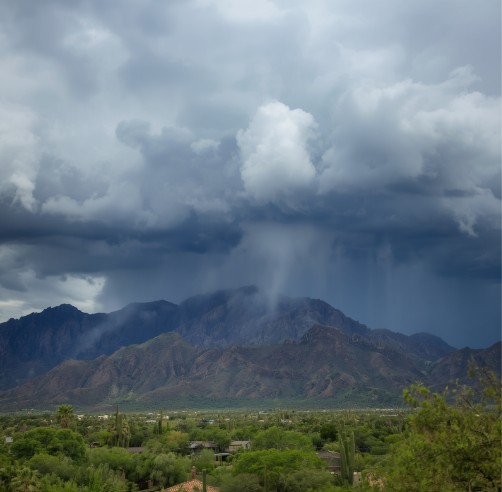
And then you look east, toward the Rincons, or north toward the Santa Catalinas, and there they are — clouds. Not the wispy kind. The kind that mean business. They build slowly, impossibly tall and bright white, and then begin their slow crawl down the mountain.
I grew up in Kansas. Summertime storms there are a different thing entirely — quick temperature drops, funky green skies, loud thunder, crackling lightning, and the occasional Dorothy-grab-Toto-and-get-to-the-basement moment.
When I moved to Tucson in 2008, the monsoon was something I’d not heard of except in movies that took place in a far-off jungle somewhere. Tucson is not a jungle. The storm doesn’t rush in and announce itself with sirens. It builds quietly — clouds on the horizon, a shift in the air, the heat going just slightly sideways. A monsoon storm is slow, and you must be patient. You learn to watch and wait. If the clouds make it all the way down the mountain, it rains. If they don’t, you hope for tomorrow.
Right before it rains — if those clouds finally make it down the mountain — the smell hits before anything else.
Here’s the thing about creosote: it’s a pale green desert shrub, unremarkable most of the year. You’d walk right past it on a dry day. But the moment rain touches creosote leaves, it releases something — a green, earthy, resinous smell that is so distinctly the Sonoran Desert that Tucsonans carry it around in their memory like a compass point. Scientists call it petrichor. We just call it rain smell.
That smell is the signal — the whole afternoon is about to change.
A Tucson monsoon doesn’t last all day — that’s the thing to understand about it.
The mornings are relentlessly sunny. The afternoons build. And if you’re lucky, the storm rolls through in an hour, leaving the streets steaming, the saguaros a shade greener, and the whole afternoon nudging me toward the studio.
My 8-to-5 is in behavioral health, so my art lives in the margins — evenings, weekends, and the quiet hours I protect because they’re precious. Monsoon afternoons make those margins feel wider. Something about the green-gold light before a storm changes how I see things in my studio. A scribble suddenly looks like the concrete breeze block on a 1960s house I’ve driven by a hundred times, or a dusty teal acrylic becomes the exact color of the sky forty minutes before lightning.
I watch the clouds start to build. I make a cold drink and turn on some smooth jazz. I pull out the ideas that have been living in the back of my mind and give them somewhere to go.
I grab plywood scraps, choose a few water-based stains, maybe some copper wire, and power up my Glowforge laser cutter. The first cut of wood has a smell of its own: warm, slightly sweet, specific in a way I can’t entirely explain but would recognize anywhere. I choose the shapes, cut the pieces, feel the textures, then sand, stain, glue, and assemble everything until it becomes something that makes me happy.
I know. People think July in Arizona is something to survive. And I won’t lie: the heat is real, the sun is relentless, and there are days you look at the thermometer and decide staying inside in air-conditioned comfort in your jammies with a good book on the couch is a perfectly acceptable substitute for any other plan that involves going “out there.”
But that’s only one version of July. If you slow down enough to watch the sky in the afternoon — if you’re the kind of person who finds beauty in the way weather moves, in the patience of clouds working their way down a mountain, in the very specific smell of a desert that finally got what it was thirsting for — July becomes something else entirely. It becomes a season for noticing. A season for waiting. A season for making.
If you want to see what this monsoon season has been turning into on my worktable, the newest pieces from the summer studio session are in my Etsy shop. And if you’d like to be the first to know when the next batch is ready, subscribe to Wanderings — I’ll send them to your inbox before they go live.
Now if you’ll excuse me . . . there are clouds building over the Catalinas and I’ve got some crafting to do.
Leave a Reply